Showing posts with label curriculum. Show all posts

Monday, May 11, 2009

How are teachers assessing with technology?

So it's been 3 weeks since I blogged last. Thanks for sticking with me. Last time I blogged I talked about the Shakespeare podcasts that my students were working on. Overall they were good, and after talking with some colleagues who have been allowing students in their classes to make videos with my class cameras I have learned a valuable lesson. Sometimes technology becomes the driving force and the curricular connection is lost. 

The Shakespeare podcast project was meant to have students learn about Shakespeare's Life and Times, and it did that very well. Students had to use Delicious.com to maintain logs of the websites they gathered information from, and then had to write a script from that research. Students added complimentary pictures and Shakespearean era music to add to the presentation of their enhanced podcasts. I did not however evaluation them based on these items. How the podcast sounds, the fading of the music and the quality of the pictures are not in the curriculum. How the product "engages the audience" is. 

This is were focus on the curriculum outcomes is critical with teachers who incorporate technology into their teaching. Here are the outcomes that I assessed when marking this project (Alberta LA 9 curriculum):

2.3- summarize the content of media texts, and suggest alternative treatments

3.1- select types and sources of information to achieve an effective balance between researched information and own ideas

3.3- use own words to summarize and record information in a variety of forms

3.4- integrate appropriate visual, print and/or media to reinforce overall impression or point of view and engage the audience. 

No where does the curriculum say, "students will using ducking, fading, images timed to the voiceovers, and audio editing through enhanced podcasting to learn about Shakespeare". 

While many teachers get excited and want to incorporate technology because it can create "cool looking products" that look great, its the learning through curricular outcomes that must be a priority. I can only hope that I can help other teachers focus on the outcomes sooner than later, so they don't have to learn the hard way, like I did. The first time I did this project, I was not focused on the outcomes. 

My advice is to ask yourself some questions before embarking on that technology infused assignment:

1. What are the students REALLY learning? Specify the outcomes, and if you can't get your program of studies out! 

2. How is technology INFUSED into the project, and not just a stand alone gimmick. Going to the lab to type out an essay, or do research is not seamlessly infusing technology. 

3. What have others done like this before? Don't reinvent the wheel. Use all of your 2.0 resources to get ideas. Tweet your idea and watch people return great advice! 

Hopefully next time you embark on your next technology infused project you'll have your program of studies out! How do you plan your assignments? 


Saturday, March 28, 2009

Assessment of Blogging In the Classroom


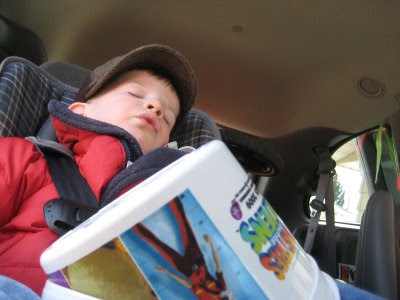
A few months ago if someone had asked be about evaluation of blog writing in my classroom, I would have given them the same look that my son did this afternoon.

It's my son at our latest outing to a 3D movie, but that's exactly the deer-caught-in-the-headlights kind of look that I might have given. Blogging in the classroom is one thing, but blogging with a purpose was something quite alien to me. Not to say that there wasn't a purpose, but I was using blogging solely as discussion starters and getting through writers block with my grade 9's. This was working very well, but as I got a new set of students in semester 2, I wanted to take our blogging to the next level. 

Thanks to my growing PLN I have worked to develop the first of 3 types of blog posts based on the grade 9 Alberta Language Arts curriculum (this link opens a PDF document). 

 A special thanks must be given to Neil Stephenson for his revisions and especially Deana Senn for her time, patience and guidance with this!

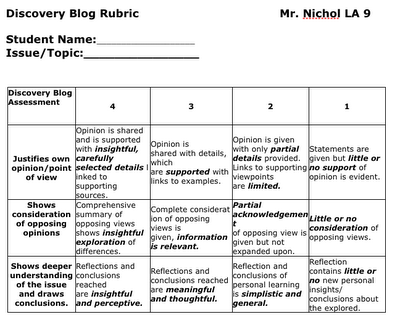
The first type of blog post that I created is called a "Discovery Blog". I pose an issue based question that students must take a side on and then must investigate further. After introducing the rubric (linked below) I realized that I was going to have to get them to practice this type of writing to gather exemplars, because I had none. We looked at several blogs (from many of you out there) and talked about the formats, and how most blogs include links to supporting sites and details. They then wrote about the journey of Chris McCandless, and I asked students if they thought that the publicity in print and on the silver screen would bring about copycats. This was their practice blog. At the end of the week they responded to the question of whether or not Chris McCandless cheated his family and friends by leaving it all behind, which I am going to evaluate this weekend. 

The Discovery Blog has 3 main components that are evaluated:

1. Defending and supporting your own opinion (with links to relevant articles, 
posts, etc. on the web)

2. Acknowledgment of the opposing viewpoint and identifying possible support details. 

3. Reaching a personal conclusion/reflection as to whether or not your opinion has changed after looking at both sides of the issue.

Here are the guiding statements that accompany the rubric:

Justification your opinion/point of view 

- Support with examples from personal experiences and the experiences of others.  

- Keywords are linked to sources that support your opinion on the issue. 


Shows consideration of other points of view 

- Examine the issue from an opposing point of view, what are the pros to their arguments? 

- Ask yourself, how do others' opinions affect your point of view? 

- Explore the differences in your opinions further. Where can you get more information on the issue/topic?

- What do you now know that you didn't before you started the process? 

- Provide evidence of your consideration and link to it in your blog post. 


Shows deeper understanding (reflection) of the issue and draws conclusions

- After considering the sources and listening to others, how do you see this issue?  

- Do you see it in another way? How has listening to others and considering other sources affected your view 

on this issue? Why did it change/not change your mind? 

- Communicate your understanding of the topic by responding to other's blogs.


The rubric for evaluation is as follows (email me: coolpoolteacher@gmail.com - and I will send you a word document so you can amend it as you please):


The students used this to practice with the first topic of publicity causing copycats. I used this first submission from their writing as exemplars. Here are two samples of their writing of varying levels. Take a moment or two and click on the large size to really read their writing. 


So, it's off to develop blog assessment #2 and #3. I'll finish them up in the week ahead to share with you, and I'll post some exemplars from the final drafts of my students writing for the Discovery Blog. PLEASE comment on what I have developed and make suggestions via email or on this blog. If you would like I can also "share" the original Google Document with you for even easier editing!


Hopefully you can now take a look at how you are using blogging in your classroom. With some work you can help take something that is still "Alien" to your students and wake them up from what can become a writing slumber.

(the popcorn and movie in 3D meant a much needed nap on the ride home from the theatre!)