Showing posts with label twitter. Show all posts

Sunday, December 5, 2010

PLN to the Rescue Again

Last weekend I was staying at my parents house for the weekend with my family. As many nerdy father son duos do, the conversation got to web tools. My dad shared how he was going to get a guest speaker to Skype into his 4th year petroleum engineering course at the U of A. His issue what getting the speaker's powerpoint (booo) deck to display at the same time as the video of his guest.

I suggested that he try Elluminate. He hadn't heard of it so I went to 'The Twitter" and asked for help from my PLN.


Within 3 minutes I had 2 responses from Jen Clevette and Alec Couros. So far I don't have a lot of experience in Elluminate, only a few sessions under my belt, and none as a moderator. Jen and Alec toured my father around all the features and let my dad upload his slide deck to try out. Inside 10 minutes my dad was sold on the tool! He's now excited to cancel his classes during the day when he's away on business and offer his class through Elluminate in the evening and teach from anywhere he is in the world.

Thanks so much to Alec Couros and Jen Clevette for your help in converting my dad. If only he'd be interested in recording the session for later use by students, but one thing at a time I guess!


Monday, April 20, 2009

Podcasts in Language Arts

This week we're starting our Shakespeare Unit for Taming of the Shrew. It's my favourite comedy by Shakespeare, but before technology this unit was quite boring in my Language Arts 9 class. 

Picture the old class: students struggling to decifer the original text, answering mundane questions, and tuning out on a daily basis because this "Shakespeare stuff" was "too hard". Students sat through note-taking in a lecture about the life and language of Shakespeare. Students did a Reader's Theatre in front of the class and that was it. A couple of quizzes and tests later and a final essay and we're done the unit!

Jump to my unit this time with technology infused and we are starting with Shakespeare's Life and Times podcasts. Students are given a topic, and must create a 1 min enhanced podcast with complimentary photos and Elizabethan era music. The podcasts are then posted on the class Shakespeare wiki for download and studying. There will end up being 22 separate podcasts for listening and studying from. I have never done this research style project this way, but so far it's been well received. While researching students were also asked to add to their delicious bookmarks and add our class tag for the unit (LA9Shake). Students are not catching on to Delicious as I would have liked, probably because I don't use it as much as I should. At some point all of the web tools out there reach a saturation point in your life and you're not as open to some things. Delicious is amazing, but I just don't find I have the fortitude to use it. 

Taking information from the podcasts, I will use their research to make quizzes for the unit. Once they are handed in tomorrow I will post them on our class Shakespeare wiki. Students will be responsible to upload more information as the unit progresses.

Technology wins again as students use the web to access  modern language versions beside the original text, which helps with answering their knowledge and comprehension questions. So should students still answer questions? It many cases, yes, but many teachers live by "chapter questions" for learning which I feel can become a crutch, a safety net, and a distraction from deeper themes that can be explored within literature. 

Today we finished the podcasts and watched the first 15 minutes if the 1960's version of Taming of the Shrew. Instead of Twitter we tried Chatzy with a private room and had great success. If I had a choice between Twitter and Chatzy for student backchannel, Chatzy wins hands down. Great control features and the ability to clear the chat room make it an excellent choice for educators. It's immediate and is not plagued by a bloated whale screen! If you're looking for a longer term discussion over a period of classes or really like to have outsiders participate then Twitter is the choice. I noticed today though that students didn't respect each other as much with their comments and tone due to the fact that they knew the chat room was private and password protected. After 5 minutes I stopped the movie, cleared the log and reviewed the backchannel rubric I developed for my Twitter adventure a couple weeks ago. 

With podcasts finished, I'll be using many of the teaching strategies described in Barrie Bennett's book Beyond Monet. In the next few weeks we'll be creating online mind-maps and concept maps, studying original source documents to learn about attitudes towards women in 16th Century vs. the 21st Century, and using our Kodak Zi6 cameras to record, edit and post modern interpretations of selected scenes in iMovie. 

I'm also contemplating the idea of students doing an audio essay instead of a traditional hand written essay. Has anyone done this before? Ideas on how to approach/plan it? How have you used podcasting in your teaching?

Stay tuned! 


Friday, April 3, 2009

Using Twitter in Language Arts Part 1

A quick post today about the Twitter experiment I performed in my Language Arts 9 class. Following what many are doing at conferences, I introduced a tag in Twitter for my students to use while tweeting about the movie Into the Wild. 

Introducing Twitter to Students

None of my students had Twitter account, nor did any of their parents. So, I started with introducing them to Twitter in general with a Commoncraft video, and explained how we can use tweets in many different ways. Showing them my own Twitter account I had them see the difference between a personal/social and a professional/educational tweet. 

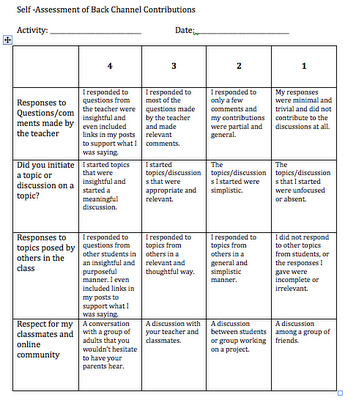
We then look at a quick rubric I developed. The rubric included the following 4 criteria:

1.  Responding to 'teacher tweets', questions and topics I give them and they need to respond to.

2. Student initiated topics that encourage discussions.

3. Student responses to topics/discussions started by their peers.

4. Respect for their peers and the online community.

Note About the Rubric
After a short meeting with our Technology Integrator Terry Kaminksi, he came up with the idea for the "Respect for classmates and online community" portion of the rubric. I am still working on connecting the wording in the rubric to the students in a meaningful manner, and this is what we came up with. I explained to the class that they need to be thinking of their Tweets in terms of a conversation with various groups  that they might encounter during the day, and how much 'off topic' talk there might be in each situation. 

4/4- a conversation with adults that would make your parents proud.

3/4- a discussion in class with teachers and peers with the occasional off topic comments.

2/4- a discussion during a student led project that goes off topic quite easily.

1/4- a discussion among friends in the hallway that is often off topic and is sometimes not appropriate.

Introducing Twitter Took Time
This pre-movie introduction of the concept of Twitter, showing the difference between a personal/social and professional Tweet, and the explanation of the rubric took about 40 minutes of our 84 min period. It proved to be very helpful and the vast majority of Tweets were on topic while watching the movie.

But then Twitter threw us a curveball...

Twitter was extremely slow while the internet raced right past it. I suggest you don't try this on a Friday afternoon when everyone and their dog is trying to waste time Tweeting what their plans are for the night instead of working. We kept getting the Twitter whale message that the service was overloaded. Tweets were taking several minutes to show up in our search. Check out our tag search here and see what we did with the first few minutes of the movie. 

Will We Tweet Again?
The short answer is YES! We will try again on Monday afternoon with the rest of Into the Wild. I will definitely use Twitter again in the class for discussions, watching films and if was lecturing (which rarely happens, but I can see it's application). The slow afternoon of Tweeting will not deter me from seeing Twitter as a great educational tool with many applications. How could you use Twitter in your class? Will you give it a try? 

Participate in the Discussion
Remember to follow our tag starting at about 12:30pm mountain time on Monday, April 6th. Feel free to tweet in about the movie or book and answer or ask questions of my students! I'll drop a few lines to summarize the experience after tomorrow's class!